Feelin’ Lousy
August 11, 2009 | My Jottings
Several months ago I received a disconcerting phone call. It was from the supervisor of one of the people we care for and have regular contact with, and she wanted me to know that T. had possibly been exposed to head lice. **Groan** Someone at T.’s work had lice, and that person’s coat had hung on the coat rack next to T.’s coat. So they just wanted us to know, so we could be aware. Because their coats had touched. Possibly.
Well, that was enough for me, and my mind went into overdrive. As soon as T. came home, I sat her down and started checking her hair and scalp. Mind you, I didn’t know what I was looking for exactly, but I thought if I looked closely enough I’d be able to see either A) little eggs, or B) a tiny live louse or two having a heyday. I didn’t find anything, but then again I wasn’t sure what to look for, so of course I went online and did some research. (A word of caution: if you like to sleep well at night, don’t go online and look at large magnified photographs of lice and their eggs.)
The more I looked, the more unnerved I became. We can’t get lice, not with all the people we have in our house! I checked everyone’s scalp and hair, looking for any sign of eggs. I checked pillows and blankets. I pored over hats and collars. Every little piece of dry skin, every flake of dandruff, each speck of lint on pillows I found, was scrutinized. Then I looked at more pictures online, but I still wasn’t certain I knew how to identify what I was looking for.
That evening, I started to itch. Badly. I scratched my head a little and tried to put thoughts of lice from my mind. That worked for seven minutes and then the itching grew in intensity and finally just became constant. I tried to look at my scalp by holding a hand mirror and standing close to another mirror, but I am “visually challenged” and couldn’t see anything but my own hair. By the time I went to bed I was certain that I, myself, had a massive and teeming lice infestation and soon the whole house would have to be tented and fumigated by a pest control agency. (As Dave Barry says, I am not making this up.) I was almost in tears. I had Michael look carefully to see what he could find, but he couldn’t see anything either. I slept fitfully that night and woke up just as itchy the next morning.
There were only three options, as I saw it. One was to panic and assume there were now billions of lice in every nook and cranny of our house, and head to the drug store to buy a case of nerve-toxic delousing liquid, and treat every person in our house immediately. Option Two was to try to use mind over matter, restrain myself from gouging and violently scraping my now-tender scalp, speak firmly and authoritatively to myself and say, “Julie, there are no lice here. Get a hold of yourself! T. doesn’t have lice, her coat doesn’t have lice, you don’t have lice, no one else in this house has lice, and you can relax now and move on.” Option Three was to call my friend Carey.
I remembered that a few years ago, Carey’s young son had gotten lice. They found out that he got them by putting on a hat that had just been on someone else’s head who had lice. Now, everyone knows that lice like to pay social calls to the nicest and cleanest of people. Having head lice doesn’t mean that someone hasn’t washed their hair, kept their house spic and span, or made personal hygiene a top priority. Usually a lice infestation means that a person was in the wrong place at the right time, as in the case of Carey’s son. To the person who has lice, this is small comfort.
Well, Carey did everything a good mother would do. She treated her son right away with the lice-and-nit-killing shampoo, and then compulsively went through his hair with a nit-comb sixteen times a day for the next three weeks. She checked her husband, her other children, and herself. She found a couple of nits in her own hair, so then treated herself. She didn’t rest until she was certain the last louse and/or nit was dead and gone from her home. It wasn’t a fun time, and I remember feeling so sorry for what Carey and her family were going through.
But now because of her experience, in my estimation Carey was a Certified Lice Expert. The next morning I called and told her about the phone call from T.’s supervisor. Carey patiently explained to me what I should be looking for, how the nits were not white and round, but were slightly elongated and like teeny, tiny beige grains of rice stuck to the hair follicles. I got off the phone and searched again, but every microscopic light-colored fleck in my house now looked like a louse egg to me. My head was so itchy and I was growing more miserable by the minute. I finally called Carey back and asked her in a voice of quiet desperation, “Carey, can I just come over and have you look at my head to see if I have lice?”
“Of course you can!” she soothed, so I grabbed the car keys, waved to Michael and headed out. In the time it took for me to drive to Carey’s house, she had gathered and set up all the essential tools for detecting whether or not I was a lousy friend, and was waiting for me at the front door when I arrived.
She had this huge magnifying glass with a bright light attached to it, she had a chair set up under the light, and she had the nit-comb in hand, which she had needed for her son years before. I sat down in the chair and braced myself. Carey was a Certified Lice Expert, and in a few minutes I would find out if The Bugs of Doom had taken up residence on my scalp, and therefore my pillows, car, carpets, beds, house, yard and neighborhood. Carey parted my hair and peered closely. She parted it again and again and examined every part of my scalp, methodically and gently. And may I add, compassionately, because she knew what kind of a dither I had worked myself into. At one point she said, “Oh, Julie, you’ve actually scratched some raw spots on your head.” I thought to myself, blood and scabs I can deal with; lice I cannot.
After about twenty minutes of careful examination, Carey straightened up and announced that I did not have head lice. What relief! What a burden lifted! I could resume my life now, and I thanked Carey profusely for being the kind of friend who would drop everything to dig through a friend’s hair to hunt for blood-thirsty insects.
It took over a day for my nerve endings to get the message that it wasn’t necessary to itch anymore. Even though my mind was at ease, I found it interesting that it took some time for my body to follow. I checked everyone in our household again and never found anything, thank God. And I was amazed at the power of suggestion, how just a hint of the possibility of something brought real symptoms.
Carey and I have laughed about this little episode in our friendship, the memory of me sitting helpless in her living room while she hovered over me, digging through my hair. Even though it gives me the heebie-jeebies to think about it, I’m grateful for her. I know that she’s the kind of friend I can turn to when I’m really feelin’ lousy.

A few days after my scalp had quieted down and things were back to the blessed ordinary, I sent Carey this picture by email to express my appreciation for how she had ministered to me. Oh, we’ve gotten more than a few chuckles out of this photo! (That’s Carey on the left, and I’m the one with the white eye-shadow. I can’t remember who the other two are.)
I told her that it was a photo of the both of us, and I titled it “True Friendship.” 🙂
Short blog holiday
August 8, 2009 | My Jottings
August 15th will be the first anniversary of this little blog, and beginning next week I am going to take a short vacation (or holiday, as they say in the UK) from posting new entries. We have much to do in the next two weeks as we prepare for our bi-annual state licensing for our business.
However, I will be auto-posting some of the blog posts for which I’ve had the most feedback, and some of the ones that have been meaningful to me in some way, so there will still be something to read each day.
If you’ve read them before, I’ll see you back in a week or so, and if you haven’t read some of the upcoming auto-posts, I hope you enjoy them.
I have many new blog posts in the works and look forward to coming back soon. I appreciate your kind comments and the encouragement over the past year. As my daughter Carolyn recently said (and she’s an actress), “If no one was reading, you’d probably just keep a diary. An actor wouldn’t go out on the stage unless there was an audience.” I agree. 🙂
Tune in these next several days for the most-read and/or commented-on posts. Thanks again for reading…
To scoot, or not to scoot?
August 6, 2009 | My Jottings
When I was in elementary school, mini-bikes were the craze. I’m not sure mini-bikes even exist anymore, but most of them had simple welded frames, noisy Briggs and Stratton engines and fat little tires. I knew a couple of people who had them, and once I learned to ride one, that was it. I wanted a mini-bike. Our next door neighbor had a red mini-bike, and I used to watch him ride it up and down our quiet street, and I just yearned to have one of my own.
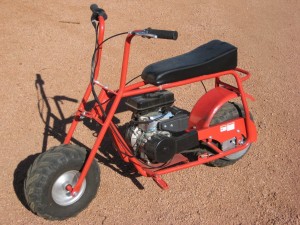
I asked my mom and dad if I could have my own mini-bike but they were hesitant to consent. Where would I ride a mini-bike? And why would I ride a mini-bike, seeing as I was ten years old and riding one on the street would have been illegal? They weren’t convinced I should have one, but I was.
Every month or so I would ask my dad, “Do you think I could get a mini-bike?” and he would respond with a hint of his old Missouri drawl, “Well now Julie, I don’t know.” Because that wasn’t a firm no, I didn’t give up. Dad even drove me to our local Sears store one afternoon to check out the three models they had on display. The cheapest one was $105.99, a lot of money in the late 1960s. I kept trying to think of ways to convince my folks I could handle the responsibility of a two-wheeled motorized vehicle while I was in the fifth grade, and tried to think of ways I could earn the money for one myself. My weekly allowance back then was $2.00, and what with going to the movies and buying Reese’s peanut butter cups, it would have taken me years to save up.
Sometimes my parents wavered, because other kids in Southern California had mini-bikes. One summer day before my sixth grade year at Workman Avenue Elementary School began, I asked my dad about it again. “If I get straight A’s in school this year, then can I pleeeease have a mini-bike?” After a long pause, my dad said “All right.” Yippee! I had a goal now, and I could just hear that putt-putt motor that would be mine in ten months’ time.
I was a pretty good student but I think my dad was counting on the fact that I usually got one or two B’s along with mostly A’s. I usually got B’s in Handwriting and Science. He probably thought it was a safe bet that I would get at least one B on my report card during sixth grade, but I set my sights on that mini-bike and didn’t let the prize ever get far from my mind.
I had Miss Nancy Curry for a teacher that year, and I loved her. I remember that we studied South America, and that she said “Ven-zoo-AY-la” instead of “Ven-ezz-WAY-la.” I still don’t know which is correct, but it sure must have made an impression if I’m remembering the way my sixth grade teacher pronounced a South American country forty years ago.
Anyway, I put forth the effort, and in June I brought home the results – straight A’s. I’m sure my parents were thinking, “What in the world are we going to do now?”
For some reason my dad wasn’t johnny-on-the-spot about taking me mini-bike shopping. He’d say things like, “Well hold on now, I said we’d get you one and we will. Don’t pester me about it.” I hated it when my parents said things like that.
One afternoon I came home from swimming at my friend Tauni’s house, and my dad said, “We’ve got a surprise for you in the garage.” Of course my heart jumped and I thought it was my little red mini-bike, but when Dad opened the garage door, what was sitting there in all its Italian glory was one of these humdingers.
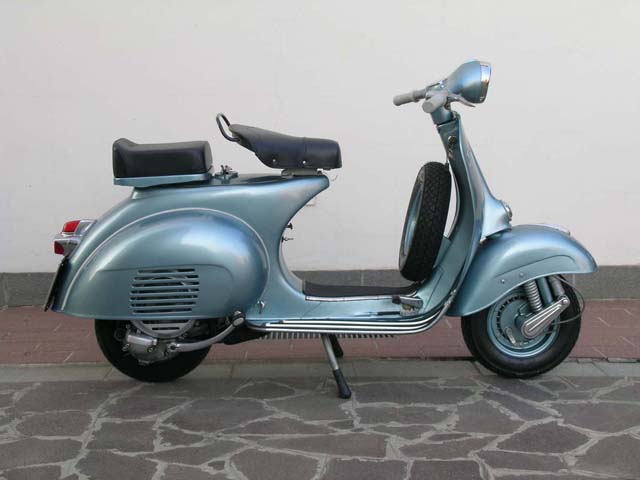
It was a used, pretty noisy 1960-something Vespa 150, and it was blue just like the scooter in the photo. The only way mine looked different from this one is that it didn’t have a spare tire.
My dad bought it from my oldest brother Larry, who had a Honda motorcycle and a Vespa so he and his wife could go riding together. Apparently the Vespa didn’t get used and my dad viewed it as a safer alternative for me. The Vespa’s engine was in the back and the chances for burning myself if I fell were much less than with a mini-bike.
It didn’t take me long to be thrilled and catch The Vespa Vision. All thoughts of red mini-bikes with chunky little tires flew out the window when I learned how to ride my 3-speed Vespa. I was eleven years old, and I mainly rode it up and down the street, up and down the street, up and down the street. Vrrrroooom, up to the Wepplo’s house. Turn around. Then vrrroooom, back down to the Pelcher’s house. Then turn around and do it all over again. Our neighbors were long-suffering people and never complained, but I’m sure they wanted to.
Once in a while I would pack a picnic lunch, put it in the fender compartment (on the other side of the back wheel) and a friend and I would ride one block to Covina High School, and ride around the track sixty or so times. We would even ride through the halls of the big school (in sunny SoCal there were no indoor halls like schools have in the Midwest), all around the baseball diamonds, and around the gym. We would stop to eat our lunch, then drive the one block home, feeling like we were the ultimate in sophisticated girl adventurers and we had traveled the world in Italian style. Except the truth was we were eleven years old with buck teeth, freckles and spindly legs.
I had my Vespa for a couple of years, and then I started getting interested in cars. My dad taught Driver’s Education in our school district and since he taught me to drive at a very young age, he used to let me back our car out of the driveway and then drive it back in, out of the driveway and drive back in, and you guessed it – soon I wanted a car. I saved up and bought my first car on my 16th birthday – you can see a photo of it and read more about it here.
Fast forward to 2009. I am 51 years old. I drive a non-descript gray van. I haven’t been on a two-wheeled conveyance of any kind in many years. But a few months ago I started thinking about my old blue Vespa. I see all the new kinds of motor scooters that people (women too) are riding, and it looks so fun. I asked my husband Michael what he thought about me buying myself a motor scooter and he said without missing a beat, “Go for it!”
Go for it? Are you saying that a woman with three adult daughters, seven grandchildren, and a bit of extra heft should really get a motor scooter to ride around town? I guess that’s what he’s saying.
I’m still trying to decide.
To scoot, or not to scoot? That is the question…
Edition 15-Wednesday’s Word
August 5, 2009 | My Jottings
Forgiveness is an act of faith. By forgiving another, I am trusting that God is a better justice-maker than I am. By forgiving, I release my own right to get even and leave all issues of fairness to God to work out. I leave in God’s hands the scales that must balance justice and mercy.
Philip Yancey
The Tooth Fairy has a name
August 4, 2009 | My Jottings
Some of my grandchildren are at the age where they’ve been losing a lot of teeth lately. It seems like every time I see the older ones, there are new gummy gaps and adorable lisps and over-sized chiclet teeth making gradual appearances.
They’re always anxious to tell me what the Tooth Fairy has left under their pillows. One morning Clara found a pack of sugarless gum and $1.00. That seemed like a normal fairy leaving. The next lost tooth was replaced with a certificate redeemable for a treat at the store, and $2.00. Not long after that the Tooth Fairy left a coupon good for an outing (like bowling or a trip for ice cream), some candy and $2.00. The most recent under-the-pillow discovery was a three dollar bill (do these exist?), some caramels, a redeemable coupon for a fun excursion, and a toothbrush and mouthwash! Apparently the Tooth Fairy is unaware that the economy has tanked and that spending is being curbed in all sectors.
The most interesting thing about the Tooth Fairy’s visits are the notes she leaves the children. Did the Tooth Fairy leave you notes when you were little? I didn’t think so. I didn’t get any notes either.
The notes she leaves before she flies back to Dentaland are written in very swirly and whimsical-looking handwriting. She writes only a few words, but the kids are so excited by these communications and they like to call me up to tell me about them.
Early on, Clara casually told me that the Tooth Fairy’s name happened to be “Flora.” Flora? I thought. I guessed perhaps the name was reminiscent of Disney’s three little fairies in Sleeping Beauty, as in Flora, Fauna and Merryweather.
But not quite. Once I finally saw one of the Tooth Fairy’s notes, I understood, and smiled at the wordplay that goes way over the children’s heads.
Lean in closely and I’ll whisper a little secret to you. You have probably never known this, and this information is something you might want to keep close to your vest….
The Tooth Fairy’s name is Fluora.
Do you get it? I’m sure you do. 🙂
This is what happens when children are born to two very creative parents who really need outlets for their creativity.
The Kindred Krageschmidts
August 2, 2009 | My Jottings
When I was a Girl Scout I used to love the songs we sang around the campfire. After a full day of hiking, tying knots, swimming, and washing our mess kits in a pan of lukewarm water, we would finally settle down for s’mores and singing. Many songs were a bit on the goofy side, but some were haunting and wistful, and sung in a round, like this one:
“Make new friends but keep the old…one is silver and the other gold.”
When I think of old friends who are like gold, I instantly think of Dale and Susan Krageschmidt. We met them in 1994 when they moved in next door to us in the old neighborhood. It didn’t take long for us to become close friends, and even though our families no longer live next door to each other, we still feel the same way about them after fifteen years.
We used to do stuff together. We had a little tradition of spending New Year’s Eve together and eating Vietnamese food for dinner. Over the years Susan and I broke open many a tube of Pillsbury Orange Rolls together, having morning tea or coffee and sharing our life stories over our tables. Susan is a fantastic cook, and some of my best recipes I’ve gotten from her. Athenian Couscous Salad. Waikiki Meatballs and Rice. Kafta, Tabouli and Hummus. Lebanese Chicken with Couscous.
The Krageschmidt’s kitchen window overlooked our den, and as Dale and Susan cooked meals together, we would smile and wave geekily at each other like The Beverly Hillbillies do at the end of each show.
Susan is the only friend I’ve ever had that I’ve felt comfortable holding hands with. I hold hands with my husband, and my children and grandchildren, and of course I gladly shake hands with people. But until I met her I had never sat comfortably and held hands with a woman friend. One wonderful evening during the Christmas season, Susan and I dressed up and enjoyed some wonderful holiday music that was being performed at a Victorian tea. She reached out to take my hand and in that gesture that I’ve never forgotten, we both spoke silently to each other, “You are my cherished friend, true and pure, a gift from God.”
Susan and Dale are both brilliant scientists, but they never make us feel like we’re dolts. They are loving and funny and insightful and humble and honest and trustworthy. We have always been able to share our hearts together. We have always prayed for one another.
After a short time the Krageschmidts welcomed William John and then Zoe Marie into their family. Michael and I were baptism sponsors for them and will never forget the glow of those days when our children were very young.
Dale and Susan and their two children, Will and Zoe, came to visit for a weekend recently. They moved to Southern Minnesota a few years ago and we haven’t seen them since then, so we were thrilled to hear of their visit and their willingness to stay with us while they were here. I’m not sure why we’re always surprised when the passage of time brings big changes (duh), but oh, how Will and Zoe had grown! Will is almost 14 and Zoe just turned 11, and he’s a wrestler and she’s an ice skater! How did that happen? They were just toddling, just yesterday it seems.
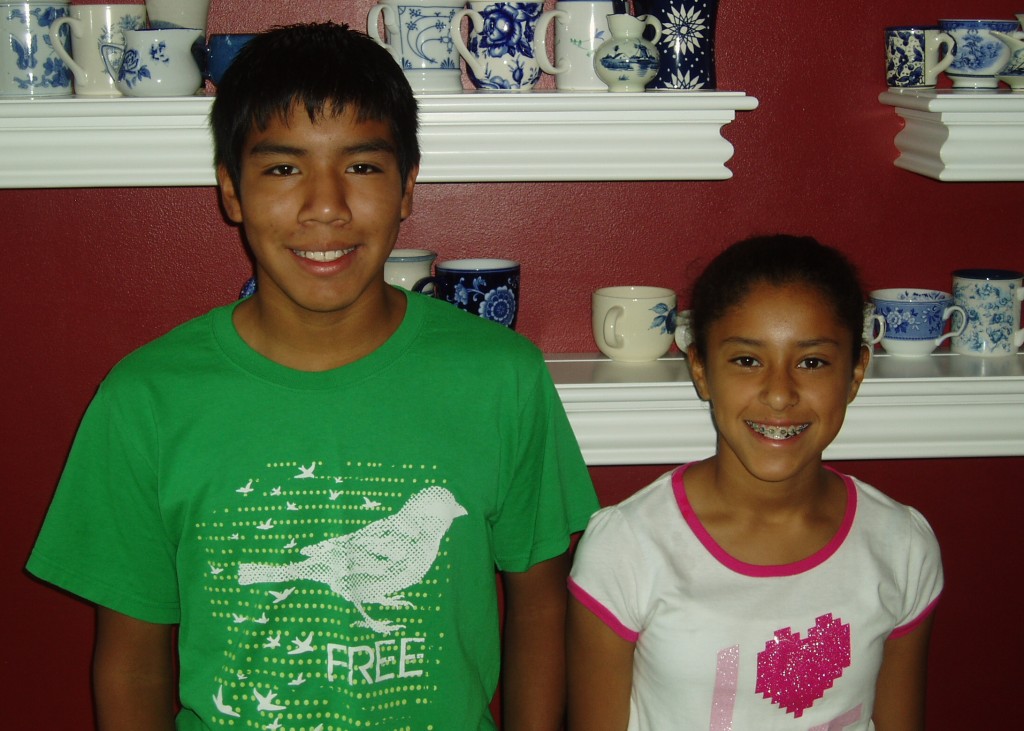
Here’s a great photo of strong and handsome Will, and graceful, beautiful Zoe, taken in our kitchen.

And this is Dale and Susan. Can you see the kindness, the sweetness on their faces?
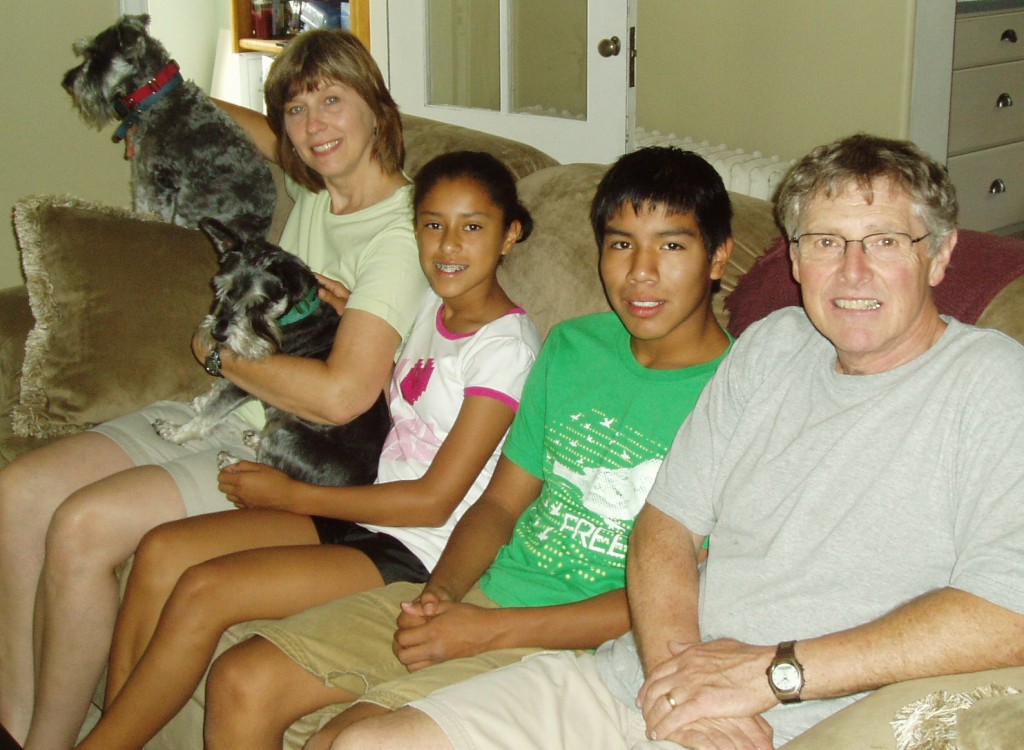
Here are the Kindred Krageschmidts in our living room, with our badly trained Schnauzers Edith and Mildred.
One of the things we’ve always loved about Dale and Susan aside from their humor and compassion is their love for dogs, and their understanding of our love for our dogs. We all talk in slightly soprano doggy voices to each other, discern and interpret our dogs’ thoughts for each other, and generally get quite caught up in our animals’ lives, which are often more exciting than our own. Living vicariously, I think you’d call it. (I hope Dale’s esteemed colleagues at The Mayo Clinic don’t happen upon this blog – I’m not sure they’d understand.) But we understand. We get it.
And our dogs know that Dale and Susan get it too. Before the Krageschmidts went home, we spent some time chatting in the living room, and our oldest Schnauzer Edith jumped up on the chair with Susan and nestled against her. 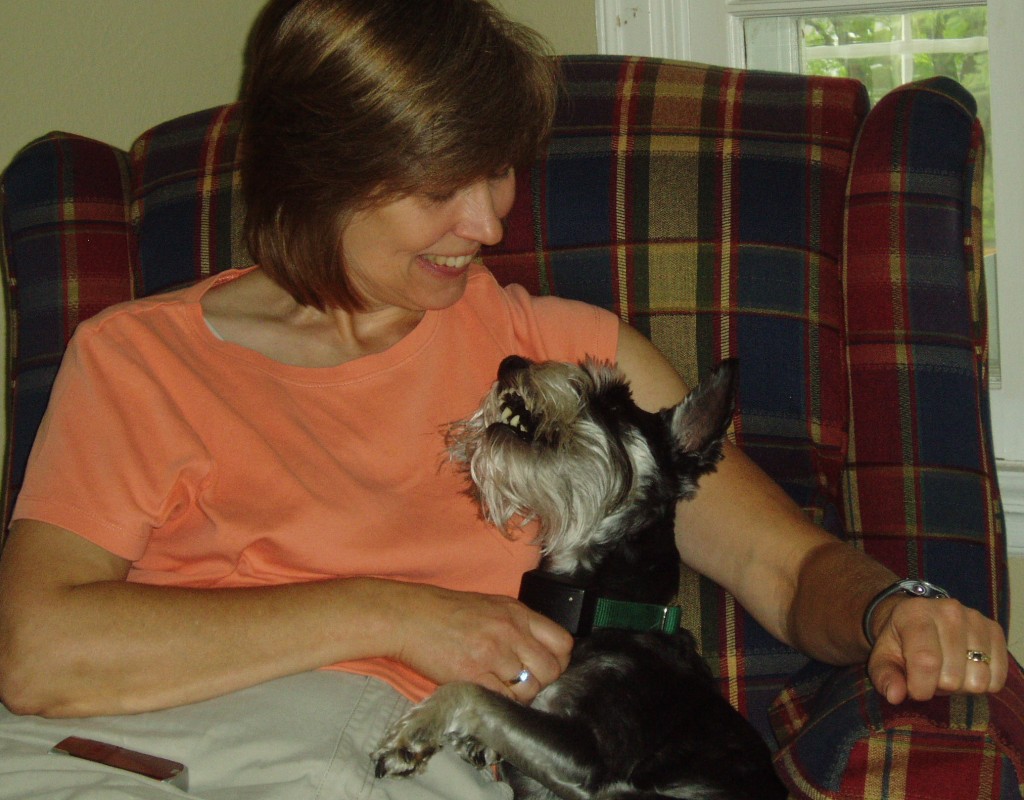 Susan crooned to Edith and gently petted her for several minutes, and Edith looked calmly and adoringly into Susan’s eyes the whole time. Pretty soon Edith did something she has never done in her entire seven years. She slowly drew back her little black lips and grinned at Susan. Almost from ear to ear. Not once, or intermittently, but continuously, for a few minutes. Edith held this doggy smile while gazing into Susan’s eyes and just poured all her doggy love into Susan’s heart. I have a feeling that Susan is the only person Edith will ever smile at like this. To me, this speaks volumes about Susan. 🙂
So we’re missing Dale, Susan, Will and Zoe already. It’s our turn to visit them next, and we hope to see them this fall before the weather turns unpredictable and blizzards whip up in no time at all.
When I was thinking of an adjective that would fit with Krageschmidt (that also started with a K, since I’m a fan of alliteration), I came up with many fitting K words that aptly describe them. Knowledgeable. Kooky. Keen. Knowing. Kind. But the word I settled on is the one that still tugs at my heart, and makes me wish they had never moved so far away. Kindred.
The Krageschmidts have always been kindred spirits to us. And after having the joy of visiting with them again, I know they will always be so.